Bournemouth | Posted on March 5th, 2026 | return to news
Work set to start to stabilise Bournemouth cliffs
There have been several cliff falls in the last 10 years, and now BCP Council is set to restore the promenade.
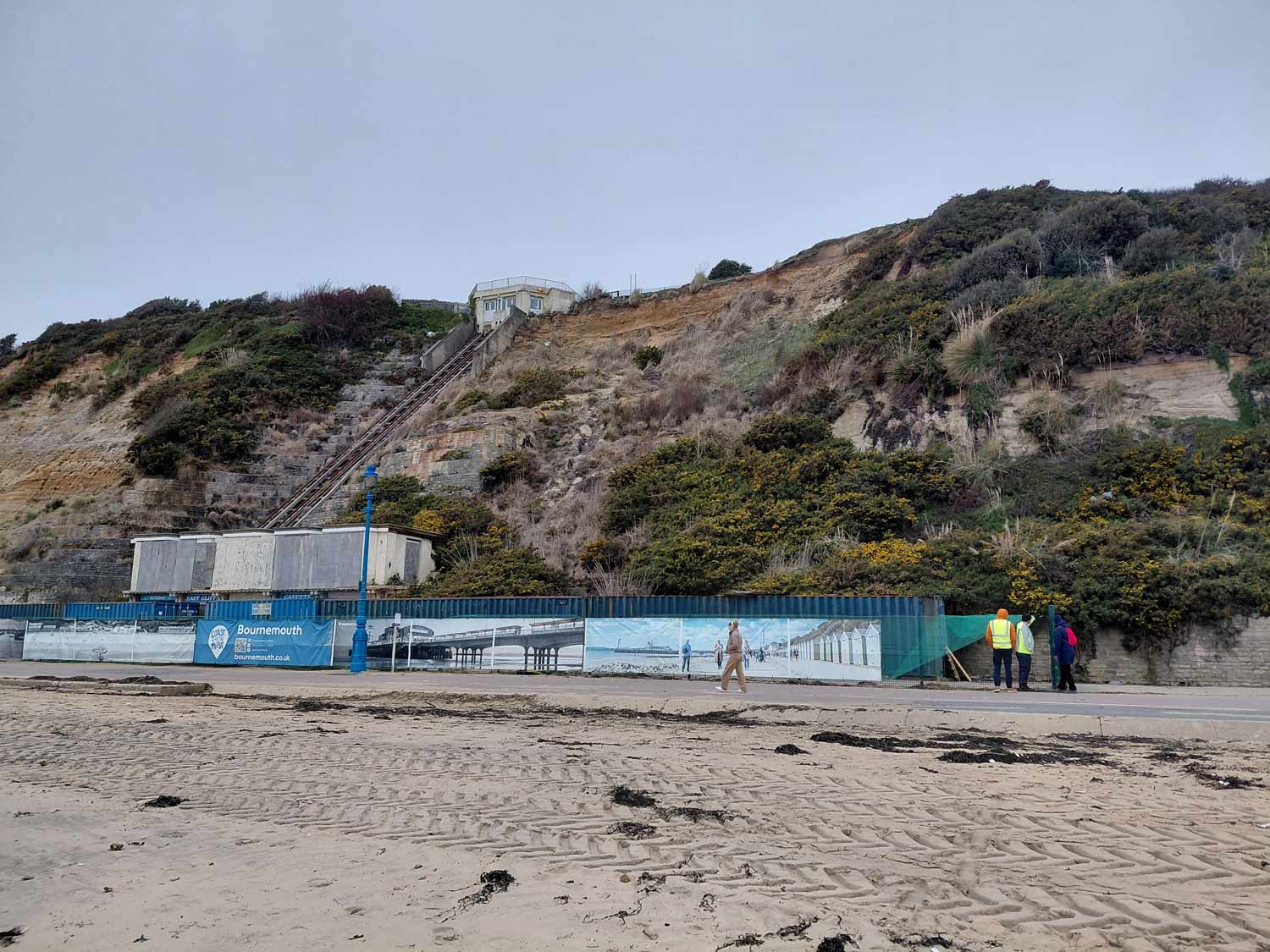
The East Cliff area of Bournemouth has seen significant cliff falls in the past few years, and in 2016 the East Cliff lifts and surrounding infrastructure were severely damaged, followed by minor slips in 2024 and 2025. Now work is set to begin later this year to restore the promenade.
Bournemouth, Christchurch and Poole (BCP) Council’s East Cliff stabilisation project is funded by a £3 million grant from the UK government.
An approved detailed design for the project is now in place, and the first phase of works is now officially out to tender, with the council inviting bids on four options to deliver core stabilisation of East Cliff.
Subject to consents, works are expected to start in September 2026 and — once underway — take around eight months to deliver, depending on weather and final engineering solutions.
Managing the cliffs along Bournemouth, Christchurch and Poole’s coastline is a complex task, spanning more than 15 miles and shaped by natural factors such as rainfall and groundwater movement. Many areas are also environmentally protected, meaning safety work must be carefully balanced with conservation requirements.

BCP Council teams work year-round to monitor cliff conditions, maintain drainage systems and prioritise action where risks are highest, always with public safety as the top priority.
Cllr Richard Herrett, BCP Council portfolio holder for Destination, Leisure and Commercial Operations, said: “Stabilising East Cliff is a major project which will help safeguard our seafront, protect nearby roads, homes and hotels, and restore access to this section of the prom for residents and visitors.
“This investment is about securing the future of one of our most iconic coastal landmarks and enhancing what residents and visitors love about Bournemouth’s coast.”
The East Cliff sits within a Site of Special Scientific Interest (SSSI) for its geological and ecological value, and the project is being undertaken in consultation with Natural England specialists.
Vegetation clearance — required to safely carry out stabilisation — will be managed outside the bird nesting season and guided by ecological surveys for bats and reptiles. Once works are complete, parts of the cliff will be reseeded with heathland species to support biodiversity.
Please share post:
LATEST NEWS:

CHARITY OF THE YEAR 2026
Subscribe to the online magazine news letter