Eco & Environment, Nature & Wildlife | Posted on August 10th, 2026 | return to news
Studland's seahorses star in new marine conservation website
Elaborate seahorse courtship and pregnancies in Studland Bay feature with other wildlife stories on the new Studland Bay Marine Partnership website.
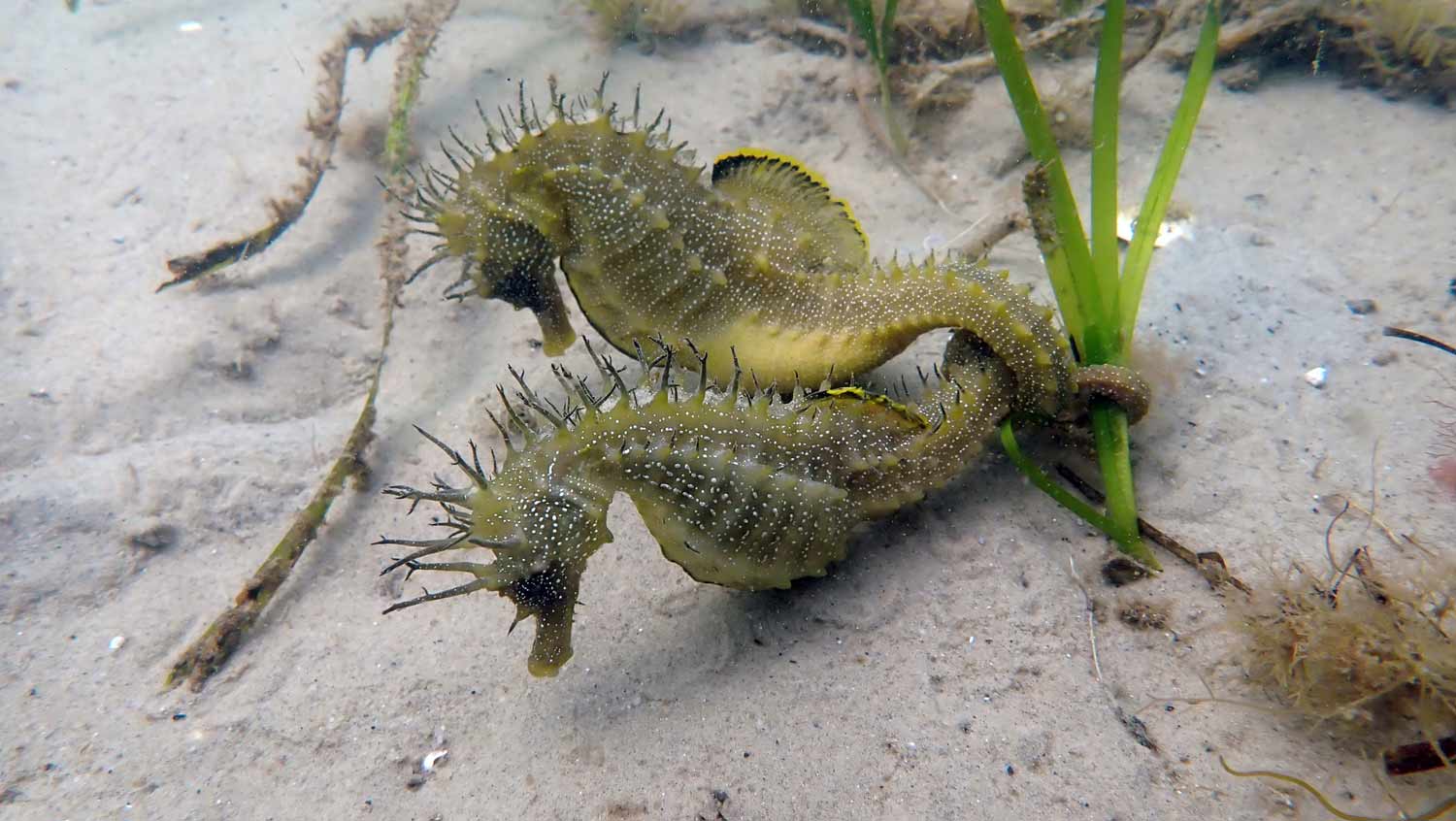
www.studlandbay.org has been created to help more people appreciate the internationally important seagrass meadows of Studland Bay. Volunteer divers recorded the elaborate seahorse courtship and pregnancies for the launch of the website, which also explains how boaters can help protect this rare and fragile marine habitat by using eco-moorings rather than traditional anchors.
Among the stories bringing the bay’s underwater world to life are observations from volunteer divers who monitor seahorses in the Marine Conservation Zone.
Studland’s seagrass meadows are home to spiny seahorses, and the occasional short-snouted seahorse, both protected under UK law. They are recorded and photographed as part of a long-running monitoring programme organised by the University of Southampton, with specialist licences held by The Seahorse Trust.
This summer, divers have observed the seahorses’ elaborate courtship rituals, including colour changes, synchronised swimming and tail entwining before the female transfers her eggs into the male’s brood pouch. They have also recorded several heavily pregnant males – they can each give birth to as many as 1,000 fully-formed babies called fry.
Neil Garrick-Maidment, Director and Founder of The Seahorse Trust, said: “To watch seahorses courting in the wild is one of nature’s great privileges. Their dances can last for days and are just one of the remarkable features of this extraordinary species. We can identify individuals through facial recognition – I observed one male with a huge brood pouch, then on the next dive it had gone, so he had obviously given birth. Monitoring them helps us better understand their lives and strengthens the case for protecting their habitat.
“We’re delighted that the new website will give more people the opportunity to learn about these fascinating animals and the work being done to safeguard them.”
Despite the recent sightings, it’s too early to say whether seahorse numbers are increasing in the bay. Divers are regularly observing around nine seahorses during surveys, but it’s too early to draw conclusions about the 2026 population trends. The annual figures won’t be available until the end of the diving season in autumn.
Not only rare, seahorses are also vulnerable creatures. While males can produce thousands of young, only a small proportion survive to adulthood. Many of the fry fall prey to bigger fish like wrasse and gobies. The species also depends on healthy seagrass meadows, which can be ripped up by traditional boat anchors.

For this reason, Studland Bay was designated as a Voluntary No Anchor Zone in 2021, and eco-moorings have been introduced to help protect the seagrass while still allowing boats to moor.
The new website also provides practical information for boaters using eco-moorings and guidance for divers on the legal requirements surrounding seahorse photography.
Cathy Lewis, Communications Officer for the Studland Bay Marine Partnership and the National Trust, said: “People are often amazed to discover that beneath the surface of Studland Bay is a rich and thriving marine landscape. The new website aims to bring that hidden world to life. Seahorses capture people’s imagination, but they are just one part of a much bigger story.
“Whether people are interested in marine wildlife, seagrass conservation or boating, we want them to understand why this habitat matters and how small actions can make a real difference to its future.”
The underwater monitoring involves around 40 volunteer divers, including university students and local recreational divers. The data they collect contributes to annual research report collated by the Studland Bay Marine Partnership.
Emeritus Research Fellow & Diving Officer , Dr Ken Collins, at the University of Southampton, said: “The seahorses may be the stars of the show, but they are also indicators of the wider health of the seagrass ecosystem. Our volunteer divers have contributed thousands of hours collecting information about the species and habitats found in Studland Bay. That long-term monitoring is helping us build an increasingly detailed understanding of how the bay is changing over time.”
The Studland Bay Marine Partnership, formed in 2021, brings together organisations and individuals committed to protecting and enhancing the seagrass meadows while still allowing people to enjoy the bay.
To find out more, visit the new Studland Bay Marine Partnership website at: www.studlandbay.org
Please share post:
LATEST NEWS:

CHARITY OF THE YEAR 2026

Subscribe to the online magazine news letter