Eco & Environment | Posted on June 9th, 2026 | return to news
Robot to combat killer weed in Dorset
A robot which detects and removes ragwort is being tested at Dorset Innovation Park, before visiting farms.
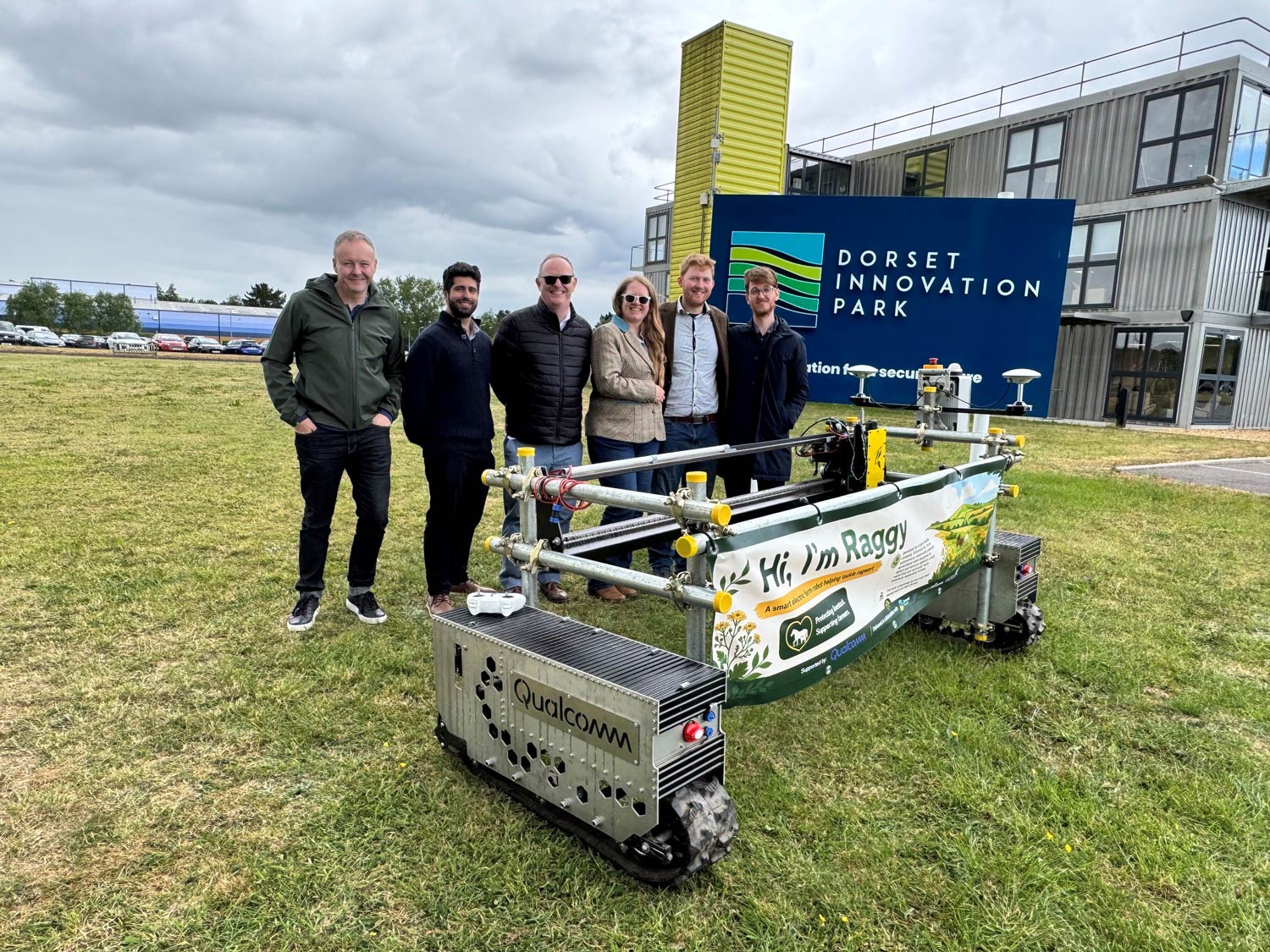
A robot will be visiting farms and land across Dorset later this summer. Dubbed ‘Raggy’ by its creators, it has been developed to detect and remove ragwort while reducing chemical use and labour.
At present it is being tested at Dorset Innovation Park’s BattleLab.
Ragwort is a poisonous weed that threatens livestock health, damages grazing land and creates major challenges for farmers and landowners. Usually it is pulled by hand, which is labour intensive, costly and can pose risks to people and the environment. Ragwort also plays an important role in supporting wildlife, including pollinators such as bees and butterflies. Control is therefore targeted, with plants removed in areas where there is a risk to grazing animals.
Raggy has been developed by south-west firm Robotriks in partnership with Dorset Council and long-time collaborators Telint and Neutral Networks using funding from Qualcomm Incorporated, through its Qualcomm for Good Initiative, which aims to enrich lives through programmes that strengthen economic and social development.
Ben Timmons, senior director of Business Development of Qualcomm Technologies International, said: “Through Qualcomm for Good, we are proud to support Dorset Council and Robotriks in harnessing edge AI capabilities to modernise agriculture and solve real-world challenges for farmers and the environment. Raggy is a powerful demonstration of what’s possible with intelligent connected technologies.”
Jake Shaw-Sutton, director of Robotriks, said: “Our Robotic Traction Unit (RTU) is fully electric and built for real-life farm conditions. It is a modular platform, designed as a flexible farm multi-tool which can perform a range of tasks across agriculture and, potentially, other sectors.
“Raggy uses advanced machine vision and connected technology, powered by the Qualcomm Dragonwing platform, to identify and remove ragwort mechanically at the root. This approach reduces the need for harmful chemicals, supports healthier soils and protects animals and habitat.”

Dave Happy, CEO of Telint, said: “This is yet another practical example of Dorset embracing innovative tech solutions to improve the quality of life for livestock and humans alike.
“Dorset’s unique advantages, in particular in relation to access to spectrum, make it the ideal place to test and develop this kind of innovative solution.”
Cllr Nick Ireland, leader of Dorset Council, said: “The team of rangers, who do a great job managing and maintaining Dorset’s fantastic country parks, nature reserves and open spaces, spend many hours each year removing ragwort by hand. We are delighted this autonomous and environmentally sensitive solution is being tested, evaluated and developed on our land here in Dorset.” Between field trials, Raggy will be maintained and stored at BattleLab, the heart of an innovation ecosystem that sets challenges to a wide range of large and small company developers and leading academic researchers working on dual-use technologies including uncrewed systems and digital device security. BattleLab and Dorset Innovation Park are key elements of a South West ‘Global Autonomy Cluster’ recently awarded up to £20 million of Government funding to enhance the region’s reputation as one of the world’s best places to develop, test and deploy autonomous technologies. The park, Dorset’s only Enterprise Zone, has an ambitious plan to create between 300 and 500 new high-value jobs on site by 2031, with the future skilled workforce coming from a research and education centre being co-created with leading university and college partners.
Please share post:
LATEST NEWS:

CHARITY OF THE YEAR 2026

Subscribe to the online magazine news letter